
Understanding AuDHD: When Autism and ADHD Overlap
AuDHD-affirming therapy
If you have ever felt pulled in two directions at once — craving routine yet struggling to stick to one, intensely focused on one thing yet unable to follow through on another — there may be a reason for that tension. You might be AuDHD.
At Vive Wellness Therapy, we specialise in AuDHD-affirming care for clients across Canada. We are AuDHD ourselves, and we offer virtual therapy in Saskatoon, Halifax, and beyond — with therapists available today.
What Is AuDHD?
AuDHD is the term used to describe the lived experience of having both Autism and ADHD. Although Autism and ADHD were once considered mutually exclusive, research now tells us they frequently co-occur. Some studies estimate that 50 to 70 percent of Autistic people also have ADHD — making this overlap far more common than previously understood.
AuDHD is not a formal diagnosis in the DSM-5. Autism and ADHD remain separate conditions that can co-occur, and AuDHD is the community-adopted term for living at that intersection. For many people, it captures something that neither diagnosis alone fully describes.
AuDHD Symptoms: What the Overlap Looks Like
Because AuDHD involves traits from both conditions, symptoms can vary greatly from person to person. The picture is shaped by the severity of each condition, the type of ADHD present (inattentive, hyperactive-impulsive, or combined), the coping strategies a person has developed, and any medications they are taking.
What makes AuDHD particularly complex is that the traits of Autism and ADHD do not simply add together — they interact with each other, sometimes amplifying one another, sometimes pulling in opposite directions. Here are some examples of how that overlap can look in practice:
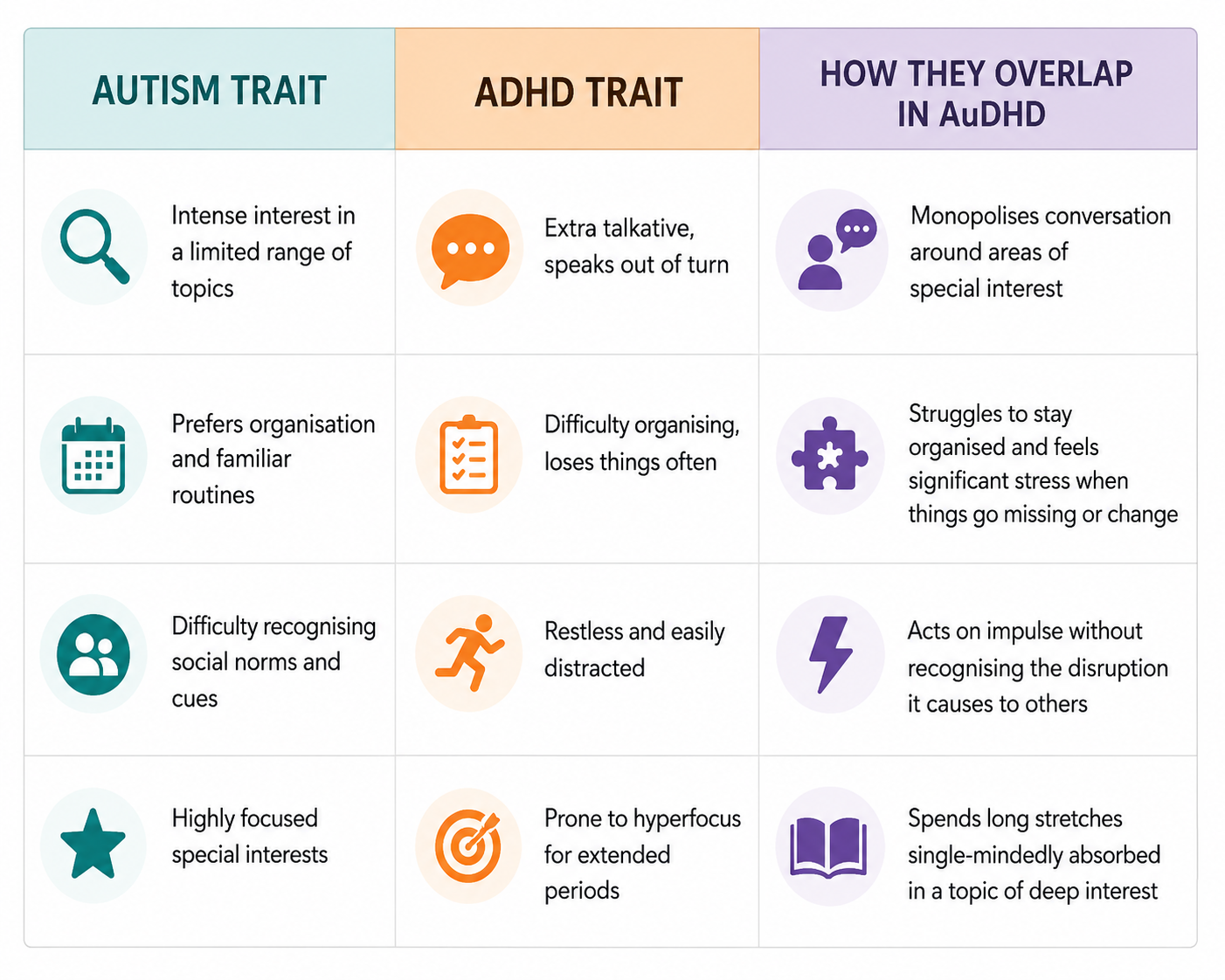
AuDHD Symptoms
The Internal Tug-of-War of AuDHD
One of the most distinctive and often exhausting aspects of AuDHD is the internal conflict between traits that pull in opposite directions. This is not a metaphor — it is a daily reality for many AuDHDers.
• Routine vs. novelty — Autism often creates a strong preference for predictability and familiar routines. ADHD, by contrast, drives a need for novelty, stimulation, and change. Living with both means being simultaneously drawn toward and resistant to new experiences.
• Hyperfocus vs. distraction — Autism can produce intense, sustained focus on areas of special interest. ADHD can make it nearly impossible to sustain focus on anything else. The result is a brain that can go very deep in one direction but struggles to redirect.
• Rigidity vs. impulsivity — Autistic traits can include a preference for order and structure. ADHD traits can include impulsive decision-making and difficulty planning. Together, these can create significant internal friction around even simple tasks.
We often see more difficulties at school, at work, and in relationships when both conditions are present. It is not simply the Autism creating challenges — it is the inattention, hyperactivity, and impulsivity layered on top of it. And for many people, the internal experience of that conflict goes unrecognised for years.
AuDHD vs. ADHD Alone
Having ADHD alone makes it harder to direct attention to certain tasks. Autism is more a matter of how a person experiences, processes, and interacts with the world around them.
Having ADHD alone does not affect social interaction and communication in the same ways that AuDHD can. ADHD alone does not affect speech development in the way AuDHD sometimes does. And ADHD alone does not produce the sensory sensitivities, social differences, or deep pattern-based thinking that are part of the Autistic experience.
When both are present, the picture is more complex — and it requires a more nuanced, personalised approach to understanding and support.
How Is AuDHD Treated and Supported?
What matters most in AuDHD support is understanding where you are struggling and why. There is no single treatment for AuDHD. Instead, care involves looking at how the combination of both conditions is affecting your life and tailoring the approach accordingly.
Medication Considerations
Medication is often a first-line treatment for ADHD in those aged 6 and older. However, for AuDHDers, the side effects can be more pronounced and more disruptive:
• Reduced appetite — Autistic people often have significant food preferences and sensory sensitivities around eating. Appetite suppression from ADHD medication can intensify these challenges.
• Sleep difficulties — Sleep problems are already common in Autistic people. ADHD medication can make this significantly harder.
• Increased irritability — ADHD medication can raise frustration and emotional reactivity. For Autistic people, this effect is often more intense, and is a common reason for reviewing or changing medication.
This does not mean medication is not appropriate — it means it requires careful monitoring and adjustment, ideally with a provider who understands both conditions.
Therapeutic and Practical Supports
Alongside medication where appropriate, AuDHD support often includes:
• AuDHD-affirming therapy — Therapy that understands the unique intersection of both conditions, addresses emotional dysregulation, supports unmasking, and works with your neurology rather than against it.
• Cognitive Behavioural Therapy (CBT) — Adapted CBT can help with goal setting, managing anxiety, and developing new thinking and behavioural strategies.
• Speech and communication support — For those who experience speech or communication differences connected to Autism.
• Executive function coaching — Practical strategies for organisation, time management, task initiation, and follow-through.
• Educational and workplace accommodations — Advocacy and guidance for accessing the adjustments you are entitled to.
Late Diagnosis and AuDHD
Many AuDHDers — particularly women, girls, and those who did not fit the stereotypical profile of either condition — go undiagnosed for decades. Years of masking, misdiagnosis, and being told that nothing is wrong can leave deep marks. Burnout, anxiety, depression, and a fractured sense of identity are common in people who receive a late AuDHD diagnosis.
At Vive Wellness Therapy, we understand this from the inside. As AuDHD therapists ourselves, we work with many clients who are newly diagnosed, self-identified, or still in the process of understanding their neurology. We offer a space that does not require you to explain or justify your experience — just to explore it.
Virtual AuDHD Therapy Across Canada
We offer virtual AuDHD-affirming therapy and neurodivergent support to clients across Canada, including Saskatoon, Halifax, and beyond. All sessions take place securely online, and our therapists are available today. You do not need to be on a waiting list or travel to access high-quality, lived-experience-informed care.
Frequently Asked Questions
What is AuDHD?
AuDHD is the term used to describe the lived experience of having both Autism and ADHD. It is not a formal DSM-5 diagnosis, but reflects the reality of a very common co-occurrence — with some research estimating that 50 to 70 percent of Autistic people also have ADHD.
Is AuDHD different from just having ADHD?
Yes. ADHD alone affects attention and impulse control. AuDHD involves the full complexity of both Autism and ADHD — including sensory differences, social processing, communication, executive function, and the unique internal tension of having traits that often pull in opposite directions.
What does AuDHD feel like?
Many AuDHDers describe a constant internal tug-of-war: wanting routine but struggling to maintain it, hyperfocusing on one thing while neglecting everything else, craving connection but finding social interaction exhausting. The experience is highly individual and shaped by the severity of each condition and the strategies a person has developed over time.
Can you have both Autism and ADHD?
Yes. Research now confirms that Autism and ADHD frequently co-occur, with studies estimating the overlap at 50 to 70 percent. For a long time, diagnostic guidelines prevented clinicians from diagnosing both simultaneously — but this is no longer the case.
How is AuDHD treated?
There is no single treatment. Care is tailored to how both conditions are affecting your life. It may involve medication (with careful monitoring given heightened side effects), AuDHD-affirming therapy, CBT, executive function coaching, and support with communication or workplace accommodations.
Do you offer AuDHD therapy in Saskatoon or Halifax?
Yes. Vive Wellness Therapy offers virtual AuDHD-affirming therapy to clients in Saskatoon, Halifax, and across Canada. All sessions take place securely online, and our therapists are available to get you started today.
Vive Wellness Therapy offers virtual AuDHD-affirming therapy and neurodivergent support to clients in Saskatoon, Halifax, and across Canada. Our therapists are available today.
